The digital world is no longer flat.
We are moving from scrolling through images to stepping inside experiences. From product photos to interactive models. From watching commercials to exploring brand universes.
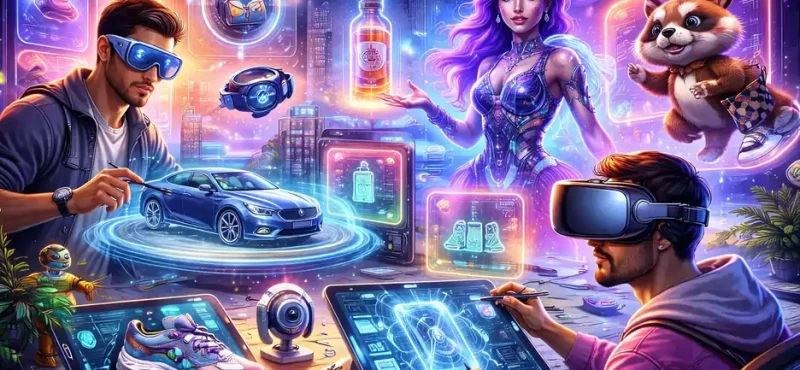
This shift is being powered by two forces: Metaverse development and Augmented Reality (AR). Together, they are redefining commercial animation and reshaping how businesses use 3D product visualization to sell, educate, and engage.
If you are a brand, manufacturer, startup, or enterprise evaluating your next move, this is not a trend article. This is a strategic conversation.
Let’s break it down clearly.
The Shift: From Viewing Products to Experiencing Them
For decades, product marketing relied on:
- Static images
- Traditional commercials
- Flat web pages
- Catalog photography
Now consumers expect more.
They want to rotate the product.
Zoom into the texture.
Place it in their room.
Try it on.
Walk through it.
This is where a metaverse development company and an experienced augmented reality developer become essential partners.
The future of commerce is immersive.
Understanding the Foundation: AR, VR & 3D Product Visualization
Before going deeper, let’s clarify the ecosystem.
What Is Augmented Reality (AR)?
Augmented Reality merges the real world with digital elements.
Through a mobile device or AR-enabled headset, a customer can:
- See a sofa in their living room
- Try on glasses virtually
- Preview machinery placement in a factory
- Inspect product scale in real space
AR brings the virtual product into the real world.
What Is Virtual Reality (VR)?
VR builds a fully virtual world.
Customers can:
- Walk inside a digital showroom
- Explore real estate before construction
- Experience a product demonstration in 3D
- Attend a virtual launch event
VR is controlled immersion. AR is blended reality.
Where 3D Product Visualization Fits
At the core of both AR and VR lies one critical element: high-quality 3D product visualization.
Without accurate modeling, photorealistic lighting, cinematic animation, and optimized assets, AR and VR experiences collapse.
This is where a professional 3D product animation studio becomes the engine behind the experience.
Why the Metaverse Is Not Optional for Commercial Brands
The digital landscape is evolving rapidly.
Statista reported mobile AR markets growing from 6.87 billion USD in 2020 to projections exceeding 26 billion USD by 2025. VR headset adoption continues rising globally.
These numbers signal one thing:
Immersive commerce is not a niche. It is infrastructure.
Forward-thinking brands are partnering with a metaverse development company to:
- Build virtual showrooms
- Launch interactive product worlds
- Host global digital events
- Create persistent brand environments
In the metaverse, your 3D assets are your storefront.
The Commercial Animation Revolution
Traditional commercial animation was linear. Watch. Absorb. Done.
Now, commercial animation is interactive.
In a metaverse-ready strategy, animation is not just storytelling. It becomes:
- A navigable space
- A clickable feature
- A configurable product
- A real-time experience
A strong 3D product animation studio understands this shift. Animation must now be built with interaction in mind.
E-Commerce Is the Primary Battlefield
The transformation is most visible in e-commerce.
Consumers increasingly prefer:
- Rotating 3D product models
- Switching colors instantly
- Viewing exploded views
- Seeing size comparisons in AR
Companies like Lenskart allow users to try glasses virtually.
Fashion brands overlay shoes through AR cameras.
Furniture brands enable room placement previews.
These experiences are built by teams that combine:
- 3D product visualization
- AR development
- Real-time optimization
The results are measurable.
Research shows:
- Up to 250% increase in conversion rates with AR
- 40% improvement in eCommerce performance through 3D visualization
- 63% of consumers prefer AR-enabled shopping
- 70% show higher brand loyalty
This is not aesthetics. It is conversion engineering.
Why Businesses Need a Metaverse Development Company
Building immersive commerce requires more than rendering.
A professional metaverse development company handles:
- Environment design
- Asset optimization
- Interactive frameworks
- Cross-platform integration
- Performance balancing
Low-quality models ruin immersion.
Overly heavy models break performance.
A serious partner balances:
- Visual fidelity
- Polygon efficiency
- Lighting realism
- Real-time loading
That balance defines commercial success.
The Role of an Augmented Reality Developer
AR is precision work.
An experienced augmented reality developer ensures:
- Correct scale mapping
- Accurate spatial placement
- Lighting adaptation to real-world conditions
- Device compatibility
AR for product visualization is not simply placing a model over camera feed.
It requires:
- Texture optimization
- Reflection calibration
- Real-time shadow blending
- Interaction controls
The better the AR execution, the lower the return rate.
Post-COVID Consumer Behavior Shift
The pandemic permanently altered buying patterns.
E-commerce grew over 30% in the US during peak lockdown periods.
Physical stores closed. Digital storefronts expanded.
Brands like BMW Singapore launched digital showrooms. Travel companies began using VR for destination previews.
Consumers grew comfortable buying without physical inspection.
3D product visualization became trust infrastructure.
That behavioral shift has not reversed.
Benefits of 3D Product Visualization in Commercial Animation
Let’s break down the core benefits.
1. Reduced Product Returns
When customers inspect products from all angles and test placement in AR, purchase confidence increases.
Fewer surprises.
Fewer returns.
2. Faster Time-to-Market
With 3D product visualization:
- Marketing assets are created before physical production
- Pre-launch campaigns become possible
- Prototype revisions happen digitally
This accelerates commercial timelines.
3. Higher Engagement
Interactive 3D models outperform static images in dwell time.
Users spend longer exploring.
Engagement correlates directly with purchase probability.
4. Consistency in Branding
Using 3D assets ensures:
- Consistent lighting
- Controlled presentation
- Uniform visual quality
Unlike traditional photography, 3D maintains complete control.
Planning for Metaverse & AR Integration
Businesses cannot randomly adopt immersive technologies.
Strategic planning includes:
Step 1: Asset Creation
High-quality, optimized 3D models are foundational.
Precision modeling and texturing are critical.
Step 2: Platform Selection
Will the experience live on:
- Website AR viewer
- Dedicated VR application
- Social AR filter
- Full metaverse platform
Step 3: Optimization
Balancing realism and performance.
Step 4: User Experience Design
Interaction must feel intuitive.
Navigation, zoom, configuration tools all require thoughtful design.
Commercial Animation in the Metaverse Era
In the metaverse, commercials are no longer 30-second clips.
They become:
- Interactive brand worlds
- Virtual product stages
- Immersive storytelling environments
Commercial animation evolves into experience design.
Brands must move from broadcasting to hosting.
Virtual Environment Design: Beyond the Product
Products need context.
Virtual environment design allows brands to create:
- Immersive showrooms
- Digital retail spaces
- Configurable interiors
- Interactive exhibitions
These environments remove geographic limitations.
A brand in India can host customers globally without physical presence.
3D Avatars and Brand Interaction
In virtual spaces, customers need representation.
3D avatars are becoming:
- Brand guides
- Digital sales assistants
- Interactive presenters
For brands, avatars create:
- Personalized experiences
- Emotional connection
- Engagement beyond static interaction
This humanizes virtual commerce.
The Future: Where This Is Heading
The trajectory is clear.
- More AR integration in mobile commerce
- Deeper VR showroom experiences
- Persistent metaverse retail environments
- AI-driven personalization in 3D environments
Commercial animation will continue merging with interactive technology.
Brands that wait will chase.
Brands that adopt early will lead.
Why Incredimate Fits This Evolution
At Incredimate, the approach combines:
- High-end 3D product animation
- Commercial animation expertise
- Technical precision
- Interactive readiness
The goal is not just to render products.
It is to build digital commerce ecosystems.
As immersive experiences become standard, businesses need a partner who understands both storytelling and system architecture.
The Impact on Sales and Growth
Data consistently shows:
- Higher engagement
- Improved conversion rates
- Increased brand loyalty
- Reduced uncertainty
Immersive product visualization bridges the gap between curiosity and confidence.
Confidence converts.
Final Thoughts
Metaverse development and AR are not abstract future concepts.
They are reshaping commercial animation today.
They are redefining 3D product visualization.
They are changing how customers evaluate products.
Businesses that understand this shift can:
- Build immersive brand ecosystems
- Reduce operational friction
- Increase engagement
- Strengthen loyalty
The question is not whether immersive commerce will dominate.
The question is whether your brand will be ready when it does.
The future of commercial animation is interactive.
The future of 3D product visualization is immersive.
And the brands that invest today will define tomorrow’s digital marketplace.
Frequently Asked Questions (FAQs)
1. What does a metaverse development company do?
A metaverse development company designs and builds immersive virtual environments where brands can showcase products, host events, and create interactive commercial experiences. This includes 3D modeling, environment design, avatar integration, and real-time optimization for platforms like VR showrooms and digital storefronts.
2. How is augmented reality used in 3D product visualization?
An augmented reality developer integrates 3D product models into real-world environments using mobile devices or AR headsets. Customers can place products in their space, inspect them in 360°, change colors, and preview size and scale before making a purchase.
3. What is the difference between AR and VR in commercial animation?
AR overlays digital content into the real world through a device camera. VR creates a fully virtual environment where users interact in a simulated space. Both technologies enhance commercial animation by making product visualization interactive and immersive.
4. Why is 3D product visualization important for e-commerce?
3D product visualization allows customers to rotate, zoom, configure, and inspect products digitally. This increases engagement, reduces returns, and improves purchase confidence. Studies show AR-enabled 3D visualization can significantly boost conversion rates.
5. How does a 3D product animation studio support commercial brands?
A 3D product animation studio creates high-fidelity product models, cinematic animations, and optimized assets for AR, VR, e-commerce, and metaverse platforms. These assets are used for interactive showrooms, product launches, marketing campaigns, and virtual demonstrations.
6. Can AR and VR increase online sales?
Yes. Research indicates that AR and VR integration can increase conversion rates by up to 250%. Customers are more likely to complete purchases when they can visualize products interactively rather than relying on static images.
7. What industries benefit from metaverse and AR integration?
Industries benefiting from immersive technologies include:
- E-commerce
- Real estate
- Automotive
- Fashion
- Furniture
- Industrial manufacturing
- Travel and hospitality
These sectors use 3D product visualization and commercial animation to improve customer experience and engagement.
8. How do immersive experiences reduce product returns?
When customers can view products from all angles, test placement in real environments, and interact with detailed 3D models, they make more informed decisions. This reduces mismatched expectations and lowers return rates.
9. What is required to launch a metaverse showroom?
Launching a metaverse showroom requires:
- High-quality 3D product models
- Virtual environment design
- Interactive navigation systems
- Platform integration
- Performance optimization
A professional metaverse development company ensures technical precision and user experience consistency.
10. Is AR and metaverse development suitable for small businesses?
Yes. Immersive product visualization is scalable. Even small businesses can use AR-enabled 3D models to enhance e-commerce listings and improve customer interaction without building a full virtual world.