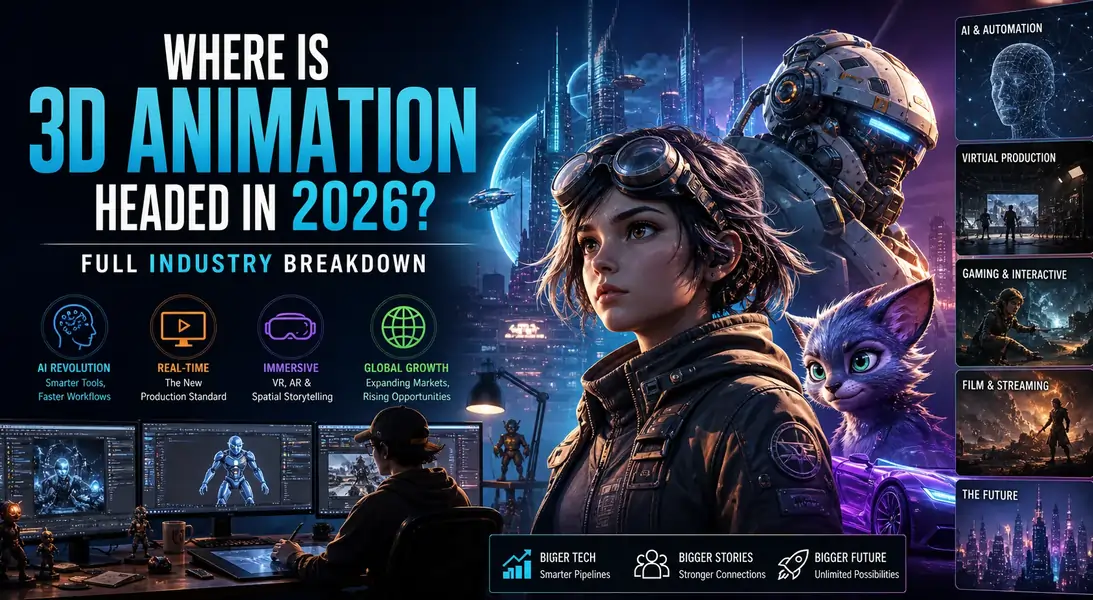
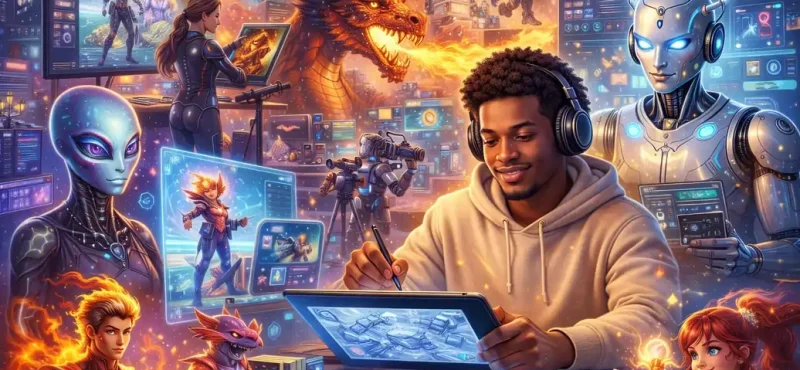
Animation is no longer a slow craft practiced only by large studios with deep pockets.
By 2026, animation has become faster, more accessible, more hybrid, and more intelligent yet paradoxically, more dependent than ever on human creativity, judgment, and storytelling instincts.
The real question facing motion designers, animators, and studios today is not:
“Which tool should I learn next?”
It is this:
What skills, workflows, and thinking will keep me relevant in 2026 and beyond?
Because the industry is not evolving linearly. It is accelerating.
This article breaks down what animation truly looks like in 2026, how AI tools are reshaping production, why fundamentals still matter, what skills creators must focus on, and how studios and individuals can adapt without losing creative identity.
Animation in 2026: A Quick Reality Check
By 2026, animation is no longer defined by manual labor or rigid pipelines. It has evolved into a hybrid, AI-assisted creative process where speed, adaptability, and storytelling intelligence matter more than tool mastery alone.
⚡ Faster Creation
AI tools now handle repetitive technical tasks like rotoscoping, in-betweening, and cleanup—cutting production time dramatically while preserving creative control.
🎨 Creativity Over Mechanics
Animators are shifting from frame-by-frame execution to directing motion, emotion, and visual rhythm—focusing on decisions, not just execution.
🧠 Smarter Workflows
Modular templates, reusable systems, and AI-assisted workflows allow studios and creators to scale content without increasing team size.
🌍 Global-Ready Output
Animation in 2026 is designed for multiple platforms, formats, and audiences—making motion design a universal language across industries.
The future of animation isn’t about replacing artists with machines. It’s about empowering creators with tools that let imagination move faster than production limits.
The Core Question: How Do You Stay Relevant in 2026?
The animation industry has always been shaped by tools,but 2026 marks a turning point where tools are no longer the bottleneck.
In the past:
- Skill = knowing software deeply
- Speed = manual efficiency
- Scale = studio size
In 2026:
- Skill = decision-making + taste
- Speed = AI-assisted workflows
- Scale = smart systems, not headcount
This shift means relying on current workflows alone is risky.
What works today may feel slow, outdated, or inefficient in just a few years.
The goal now is not to chase every new tool but to build a future-proof skillset.
Why Motion Design Still Matters (More Than Ever)
Despite fears that AI will “replace” creatives, motion design is not shrinking.
It is expanding into more areas than ever before.
Key Benefits of AI-Powered Animation
| Benefit | What It Means for Creators & Studios |
|---|---|
| ⏱ Faster Production | Less time spent on repetitive tasks like cleanup, masking, and in-betweening |
| 🎨 More Creative Freedom | Animators focus on emotion, pacing, and storytelling instead of mechanics |
| 💰 Cost Efficiency | High-quality output without massive budgets or infrastructure |
| 🌍 Global Scalability | Content adapted easily for multiple platforms and audiences |
| 🧠 Smarter Workflows | Reusable systems and templates improve long-term efficiency |
Visual Content Dominates Digital Communication
Every digital surface now moves:
- Websites
- Apps
- Ads
- Social media
- Interfaces
- Games
- Virtual spaces
Motion is no longer decoration.
It is communication.
Animation:
- Explains faster than text
- Grabs attention faster than images
- Conveys emotion more effectively than static visuals
This is why demand for:
- Explainer videos
- Motion ads
- UI motion
- Interactive visuals
continues to grow globally.
The Takeaway
By 2026, motion design is not optional.
It is foundational to modern creative work.
The Tools That Matter in 2026 (And Why)
Tools will always change.
Principles won’t.
Still, understanding where tools are heading is critical.
After Effects: Still the Backbone
Despite the rise of AI, After Effects remains central in 2026.
Why?
Because it sits at the intersection of:
- Design
- Timing
- Narrative
- Compositing
- Control
Core AE skills still define professional quality:
- Keyframes
- Graph editor mastery
- Easing and timing
- Masks and mattes
- Layer-based storytelling
Most studios and freelancers still rely on AE for:
- Titles
- Explainers
- Narrative motion
- Branding animation
AI has not replaced After Effects it has augmented it.
AI Tools: Assistants, Not Artists
In 2026, AI is no longer experimental.
It is embedded.
AI tools now handle:
- Rotoscoping
- Masking
- Cleanup
- Asset generation
- In-betweening
- Motion refinement
This reduces production time by up to 68% in many pipelines.
But here’s the key distinction:
AI speeds up execution.
Humans define intent.
AI does not decide:
- Timing
- Emotion
- Story beats
- Visual hierarchy
Designers who treat AI as a collaborator not a shortcut win.
The New AI Animation Stack (2026)
Here’s how the ecosystem looks now:
Concept & Ideation
- Runway (Gen-4+) for text-to-video, masking, compositing
- Kling & Google Veo 3 for high-fidelity generative visuals
Character & Motion
- Autodesk Flow Studio for CG-in-live-action automation
- Cascadeur for AI-assisted keyframing and physics realism
- DeepMotion & RADiCAL for markerless motion capture from video
Story & Scenes
- LTX Studio for AI-driven scene building and storytelling
- AutoDraft AI for browser-based cartoon animation
These tools don’t replace animators.
They compress timelines.
What Skills Matter More Than Tools
This is where many creators misunderstand the future.
Skills That Matter Most in the New Creative Age
| Skill Area | Why It Matters |
|---|---|
| Animation Fundamentals | Timing, spacing, and motion principles never become obsolete |
| AI Fluency | Knowing how to guide AI outputs instead of blindly using tools |
| Adaptability | Quickly evolving workflows as technology changes |
| Cross-Disciplinary Thinking | Blending 2D, 3D, motion, and real-time tools |
Animation Fundamentals Are Non-Negotiable
AI can generate motion but it cannot judge motion.
Fundamentals still rule:
- Timing
- Spacing
- Weight
- Anticipation
- Follow-through
- Arcs
Without fundamentals, AI output looks:
- Floaty
- Generic
- Emotionless
By 2026, fundamentals separate operators from creators.
Adaptability Is the Real Superpower
The industry no longer rewards:
“I know this tool really well.”
It rewards:
“I can adapt quickly.”
Adaptable creators:
- Test new tools without fear
- Integrate AI selectively
- Update workflows regularly
- Learn continuously
Stagnation is now the biggest risk.
Multi-Disciplinary Fluency Wins
By 2026, specialization alone is limiting.
The most valuable creators:
- Combine 2D + 3D
- Understand basic expressions/scripting
- Can supervise AI outputs
- Know real-time engines
- Think in systems
You don’t need mastery of everything but fluency matters.
Workflow Thinking Beats Tool Collecting
A major shift in 2026 is strategy over software.
How Animation Workflows Flow in 2026
| Stage | How It Works in 2026 |
|---|---|
| Idea & Concept | AI-assisted ideation with human creative direction |
| Design & Assets | AI-generated drafts refined by designers |
| Animation | AI-assisted keyframing, motion capture, and physics-aware movement |
| Polish & Refinement | Human-led timing, emotion, and storytelling decisions |
| Delivery | Multi-platform output from a single production pipeline |
Successful studios and creators:
- Build reusable templates
- Automate repetitive tasks
- Use plugins intentionally
- Design systems, not just shots
Plugins like:
Cool tools without workflow strategy = wasted potential.
- Duik
- Animation Composer
- Red Giant Suite
still matter but only when aligned with production goals.
Major Animation Trends Shaping 2026
1. AI-Assisted Workflows
AI handles technical labor.
Humans focus on creative decisions.
2. Hybrid 2D + 3D Styles
Flat meets dimensional.
Stylized realism becomes the norm.
3. Motion-Integrated UI
Animation moves beyond video into product design.
4. Modular & Reusable Systems
Templates save time when deadlines shrink.
Animation Before vs Animation in 2026
| Aspect | Traditional Animation (Before) | AI-Driven Animation (2026) |
|---|---|---|
| Production Speed | Slow, manual, frame-by-frame work | AI-assisted workflows reduce time by up to 60–70% |
| Team Size | Large teams required | Small teams with smarter systems |
| Motion Capture | Expensive suits and studios | Markerless AI motion capture from video |
| Iteration | Limited concepts due to time constraints | 10+ creative ideas tested quickly |
| Creative Focus | Execution-heavy | Decision-making and storytelling-led |
How AI Is Transforming Animation Production
Motion Capture Without Suits
AI enables motion capture using:
- Phones
- Webcams
- Simple video
This democratizes 3D animation.
Automatic In-Betweening
AI fills frames between key poses in 2D animation, cutting manual labor drastically.
AI-Driven Lip Sync
Tools generate facial animation from voice data faster, cleaner, scalable.
Virtual Production & Crowds
Real-time engines and AI-driven crowd systems create complex scenes instantly.
How Careers Are Changing
From Technician to Director
Animators now:
- Supervise AI outputs
- Guide motion quality
- Make creative calls
Manual repetition is fading.
Faster Prototyping
Studios test 10 ideas where they once tested 1.
New Roles Emerging
- AI Animator
- Motion Capture TD
- Real-Time Artist
- Pipeline Strategist
Smaller teams now compete with big studios.
Do’s and Don’ts for Animators in 2026
Do
- Master fundamentals
- Learn AI as workflow support
- Build systems
- Stay curious
Don’t
- Rely on one tool
- Skip fundamentals
- Chase trends blindly
- Let AI replace judgment
The Future of Animation Is Human-Led
What the Future Holds for Animation
| Outcome | Impact on the Industry |
|---|---|
| AI-Generated Films | Full-length productions created by small, agile teams |
| Hybrid Visual Styles | 2D, 3D, and real-time visuals blending seamlessly |
| New Creative Roles | AI Animators, Motion TDs, and Real-Time Artists in demand |
| Higher Creative Standards | Consistency and storytelling become the new benchmarks |
The irony of 2026 is this:
As tools become smarter, human taste becomes more valuable.
AI can generate motion.
Only humans create meaning.
Studios that understand this are building:
- Faster pipelines
- Stronger identities
- Sustainable creative futures
Final Thoughts
Animation in 2026 is not about fear.
It is about clarity.
Those who:
- Respect fundamentals
- Embrace AI intelligently
- Build adaptable workflows
- Think long-term
will not just survive.
They will lead.
The new creative age is not automated.
It is augmented.
And the animators who thrive will be the ones who understand that technology is a tool but imagination remains the engine.
FAQs
1: What will animation look like in 2026?
Animation in 2026 will be faster, more hybrid, and AI-assisted. AI tools will handle repetitive tasks like rigging, rotoscoping, and in-betweening, while humans focus on creativity, storytelling, and motion quality.
2: Will AI replace animators by 2026?
No. AI will not replace animators it will augment them. The role of animators is shifting from manual execution to creative direction, supervision, and decision-making.
3: Is After Effects still relevant in 2026?
Yes. After Effects remains a core tool for 2D motion graphics, compositing, and narrative animation. AI tools enhance After Effects workflows rather than replacing them.
4: What AI tools are most important for animation in 2026?
Key AI tools include Runway, Autodesk Flow Studio, Cascadeur, DeepMotion, RADiCAL, Google Veo, Kling, NVIDIA Omniverse, and AI-assisted lip-sync and motion tools integrated into major software.
5: What skills should animators focus on for the future?
Animators should focus on:
- Animation fundamentals (timing, easing, weight)
- Adaptability to new tools
- Hybrid 2D + 3D workflows
- AI-assisted production strategies
- Creative decision-making
6: How is AI changing animation workflows?
AI reduces production time by automating technical tasks such as cleanup, motion capture, environment creation, and character animation allowing teams to prototype faster and scale efficiently.
7: Are animation jobs increasing or decreasing by 2026?
Animation jobs are evolving, not disappearing. New roles like AI Animator, Motion Capture TD, and Real-Time Artist are emerging as demand grows for fast, high-quality visual content.
8: What are the biggest animation trends expected in 2026?
Major trends include:
- AI-assisted workflows
- Hybrid 2D + 3D animation
- Motion-integrated UI/UX
- Real-time rendering
- Reusable animation systems
9: Can small studios compete with big studios using AI?
Yes. AI tools allow small teams to produce studio-quality animation, reducing costs and production time while maintaining creative control.
10: How should studios prepare for the future of animation?
Studios should invest in:
- Training teams on AI-assisted tools
- Building scalable workflows
- Maintaining strong creative fundamentals
- Embracing experimentation while preserving quality standards