The animation and filmmaking industries are moving through one of the most exciting technological transitions in decades. Characters that once required months of manual animation can now move with stunning realism in real time. Entire digital performances can be captured from a single actor and instantly transferred to animated characters, virtual avatars, or game engines. At the center of this transformation lies motion capture technology.
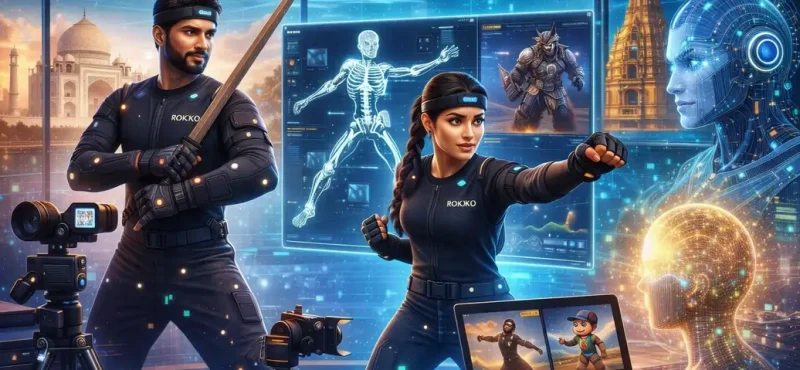
In 2026, motion capture in India is evolving rapidly. Technologies such as Rokoko motion capture suits, AI-assisted mocap systems, and real-time animation pipelines are changing how studios produce films, games, and immersive digital experiences.
Studios across the world are adopting these workflows because they combine the best of human performance and digital creativity. Instead of animating every frame manually, motion capture allows creators to capture real performances and translate them directly into animation.
For creative studios like Incredimate, which specialize in 3D animation, CGI production, virtual storytelling, and digital experiences, motion capture has become a key part of modern animation pipelines. It enables faster production, realistic character movement, and scalable workflows for films, advertising, games, and immersive content.
This article explores how motion capture technology is evolving in India, the role of Rokoko motion capture systems, the rise of AI-driven mocap tools, and how real-time animation workflows will shape the future of digital storytelling.
What is Motion Capture?
Motion capture, often referred to as mocap, is a technology used to record human movement and translate it into digital animation data.
Actors perform movements while wearing motion capture suits or sensors, and specialized systems track these movements in real time. The captured motion data is then applied to digital characters, allowing them to move naturally and realistically.
Instead of manually animating every motion, animators can capture authentic human performances and apply them directly to characters.
Motion capture is widely used in:
- Film production
- Video game development
- Animation studios
- Virtual production pipelines
- AR and VR experiences
- Sports science and biomechanics
- Robotics and AI research
For studios like Incredimate, motion capture enables highly realistic character animation while significantly reducing production time compared to traditional keyframe animation.
The Evolution of Motion Capture Technology
Motion capture technology did not appear overnight. It evolved through decades of research and innovation.
Early Motion Capture Experiments
The earliest forms of motion capture appeared in research labs during the 1970s and 1980s. These systems tracked body movement using sensors attached to actors.
However, these early systems were expensive and limited in accuracy.
Optical Motion Capture Systems
Optical motion capture became the standard for major film productions. Actors wore suits covered with reflective markers while multiple cameras tracked their movements.
This system produced highly accurate data and was widely used in blockbuster films and AAA video games.
However, optical mocap required:
- specialized capture studios
- complex camera setups
- controlled environments
Inertial Motion Capture
The next major breakthrough came with inertial motion capture suits.
Instead of cameras, these suits use sensors such as gyroscopes and accelerometers to track movement.
This approach allows motion capture to be used outside specialized studios.
Modern Rokoko motion capture suits belong to this category. They are portable, wireless, and easier to deploy in real production environments.
Real-Time Motion Capture
Today, motion capture systems can deliver real-time animation results.
Actors perform while the digital character moves instantly on screen. This real-time feedback allows directors and animators to adjust performances immediately.
Real-time workflows are widely used in:
- film previsualization
- game development
- virtual production
- live digital performances
The Growth of Motion Capture Studios in India
India’s animation and VFX industry has expanded rapidly in recent years.
As global demand for digital content increases, motion capture studios in India are becoming an essential part of the production ecosystem.
Indian studios now work on projects across industries including:
- films and streaming platforms
- game development
- advertising and brand storytelling
- educational simulations
- virtual production environments
Cities such as Mumbai, Hyderabad, Bangalore, and Delhi have become hubs for animation and VFX production.
Studios like Incredimate are part of this growing ecosystem, offering advanced animation and CGI services that align with global production standards.
Rokoko Motion Capture and the New Mocap Revolution
One of the technologies driving this change is Rokoko motion capture.
Rokoko systems are designed to make motion capture more accessible and flexible. Instead of requiring a large capture stage, Rokoko suits allow creators to capture motion almost anywhere.
Key features of Rokoko mocap technology include:
- wireless motion capture suits
- finger tracking for hand animation
- facial capture integration
- compatibility with major 3D software
- real-time animation streaming
These systems are used by:
- animation studios
- indie creators
- game developers
- virtual production teams
For studios like Incredimate, Rokoko technology enables scalable motion capture workflows that can support multiple animation and CGI projects.
AI Motion Capture vs Traditional Mocap
As generative AI tools continue to evolve, many creators wonder if AI will replace motion capture systems entirely.
The answer is more nuanced.
AI motion tools are improving quickly, but they do not fully replace traditional mocap pipelines.
What AI Motion Tools Can Do
AI motion tools analyze video footage and generate motion data using machine learning.
These tools can:
- transfer movement between characters
- generate quick animation prototypes
- assist with previsualization
- create stylized motion sequences
For concept videos, short clips, or social media content, AI motion tools can be powerful.
Limitations of AI Motion Capture
However, AI motion tools still face several limitations.
Most AI-generated motion systems:
- rely on single-camera video input
- produce limited 3D motion data
- cannot easily support multi-camera shots
- offer limited editing flexibility
This means they are not suitable for:
- game development pipelines
- interactive environments
- complex cinematic productions
- reusable animation assets
In contrast, true 3D motion capture systems provide flexible and reusable animation data.
Why Motion Capture Still Matters in 2026
Despite the rapid growth of AI animation tools, motion capture remains essential for high-quality digital production.
True 3D Motion Data
Motion capture systems produce full skeletal animation data that can be edited and reused across multiple scenes.
Flexible Camera Angles
Once motion is captured, it can be viewed from any camera angle.
AI-generated motion often locks the result into a fixed perspective.
Iteration and Editing
Motion capture performances can be refined without recreating the entire scene.
AI systems often require regenerating motion from scratch.
Integration with Production Pipelines
Game engines, animation software, and film pipelines rely on mocap data because it integrates easily with production workflows.
Real-Time Animation Workflows
Another major trend shaping motion capture in 2026 is real-time animation.
In real-time pipelines, animators can see digital characters move instantly while actors perform.
This approach is widely used in:
- game development
- virtual production
- interactive experiences
- metaverse environments
Game engines like Unreal Engine allow mocap data to drive digital characters in real time.
For studios like Incredimate, real-time workflows help accelerate production while maintaining creative flexibility.
Motion Capture Suits vs Suitless Mocap
Traditional motion capture relies on specialized suits equipped with sensors.
However, new suitless motion capture technologies are emerging.
Suitless mocap systems use cameras and AI algorithms to track body movement without requiring a wearable suit.
Advantages of Suitless Motion Capture
Suitless systems offer several benefits:
- faster setup times
- lower equipment costs
- easier accessibility for creators
- natural performer movement
These systems are particularly useful for independent creators and smaller studios.
Why Motion Capture Suits Still Matter
Despite these advantages, motion capture suits remain the most reliable solution for professional production.
Suit-based systems offer:
- higher tracking precision
- stable motion capture data
- reliable integration with animation pipelines
- consistent performance capture
For high-end film and game production, motion capture suits remain the industry standard.
Motion Capture Beyond Entertainment
Motion capture technology is not limited to film and gaming.
Many industries are adopting mocap systems for practical applications.
Healthcare and Rehabilitation
Doctors use motion capture to study human movement and design rehabilitation programs.
Sports Science
Athletes use mocap systems to analyze performance and improve movement efficiency.
Robotics and AI Training
Robotics researchers use motion capture data to train humanoid robots to replicate human movements.
Virtual Reality and the Metaverse
Motion capture plays a key role in creating immersive digital experiences and realistic avatars.
The Future of Motion Capture in India
Looking ahead, several trends will shape motion capture technology in India.
AI-Assisted Animation
AI tools will assist motion capture workflows by cleaning animation data and generating secondary motion.
Portable Motion Capture Systems
Technologies like Rokoko will make mocap accessible to smaller studios and independent creators.
Real-Time Production
Real-time animation will become the standard for many digital production pipelines.
Hybrid AI and Mocap Workflows
Future pipelines will combine AI-generated motion with real human performances.
Why Motion Capture Matters for Studios Like Incredimate
For studios that produce animation, CGI, and digital storytelling, motion capture provides several advantages.
Studios can:
- create realistic character animation
- accelerate production timelines
- reduce manual animation workload
- improve creative collaboration
For companies like Incredimate, which focus on advanced animation and CGI production, motion capture helps deliver high-quality digital content for global clients.
Conclusion
Motion capture in India is entering a transformative era.
With technologies like Rokoko motion capture, AI-driven mocap tools, and real-time animation workflows, creators now have unprecedented control over digital performance.
AI tools will continue to evolve and complement animation pipelines, but they are unlikely to replace motion capture entirely.
Instead, the future lies in combining human performance, advanced technology, and creative storytelling.
Studios that embrace these technologies will shape the next generation of digital entertainment.
And in that future, motion capture will remain one of the most powerful tools for bringing digital characters to life.
FAQ Section
1. What is motion capture technology?
Motion capture (mocap) is a technology that records human movement and converts it into digital animation data. Actors perform actions while wearing motion capture suits or being tracked by sensors and cameras, and that data is applied to digital characters for realistic animation in films, games, and virtual production.
2. What is Rokoko motion capture and how does it work?
Rokoko motion capture is a portable inertial motion capture system that uses sensor-based suits to track body movements in real time. Unlike traditional optical mocap systems that require multiple cameras, Rokoko suits capture motion through built-in sensors and stream the animation data directly into 3D software.
3. Are motion capture studios available in India?
Yes. Motion capture studios in India are growing rapidly due to increasing demand for animation, VFX, gaming, and virtual production. Many studios now provide mocap services for films, commercials, game development, and digital experiences.
4. Can AI replace motion capture in animation?
AI motion tools can generate animation from video input, but they usually produce limited motion data and cannot fully replace professional motion capture systems. Motion capture still provides accurate 3D performance data that can be reused, edited, and applied across multiple scenes.
5. What is the difference between AI mocap and traditional motion capture?
AI mocap analyzes video footage to estimate body movement, while traditional motion capture uses suits or sensors to capture precise skeletal motion data. Traditional mocap provides more control, better accuracy, and reusable animation assets for professional production pipelines.
6. What industries use motion capture technology?
Motion capture technology is widely used in films, video games, animation studios, sports science, healthcare research, robotics, virtual production, and AR/VR development.
7. What is real-time animation in motion capture?
Real-time animation allows digital characters to move instantly while the actor performs. Mocap data streams directly into 3D software or game engines, allowing directors and animators to see the performance live during production.
8. Do motion capture suits provide accurate animation?
Yes. Motion capture suits equipped with sensors or markers can capture highly detailed body movements. Professional mocap suits track body motion, hand gestures, and sometimes facial expressions, allowing animators to create realistic digital characters.
9. What is suitless motion capture?
Suitless motion capture uses AI-based tracking and cameras instead of wearable suits. It analyzes human movement from video footage to generate animation data. While it is easier to set up, suitless mocap may be less precise than professional motion capture suits.
10. Why is motion capture important for modern animation studios?
Motion capture helps studios create realistic character animation quickly and efficiently. Instead of manually animating every movement, studios capture real human performances and convert them into digital animation, improving both realism and production speed.