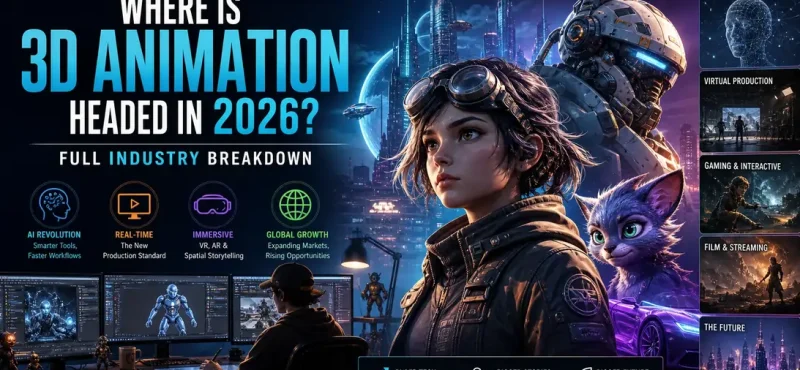
Introduction: The Big Question
“Is learning 3D animation still worth it in 2026… or is AI about to eat the whole industry?”
That question is echoing across classrooms, Discord servers, and studio corridors. It’s not paranoia. The tools are evolving fast. Pipelines are shrinking. Tasks that once took days now collapse into minutes.
But here’s the sharper truth:
The future of 3D animation in 2026 is not about replacement. It’s about redefinition.
This isn’t a funeral for creativity. It’s a reshuffling of power. The people who adapt will move faster than ever. The ones who don’t… will feel like the ground disappeared.
Let’s break this down properly. No fluff. No hype. Just where the industry is actually heading.
AI in 3D Animation: Acceleration, Not Replacement
AI has entered the pipeline like electricity entered factories. It didn’t eliminate work. It changed who does what.
What AI Is Already Doing Well
- Auto-rigging characters in minutes
- Cleaning motion capture data
- Generating base meshes and environments
- Upscaling renders and optimizing lighting
- Assisting with physics simulations
Tools integrated into ecosystems like Blender, Autodesk Maya, and Unreal Engine are quietly shaving hours off production.
Studios love this. Time saved = budget saved.
What AI Still Cannot Do
- Craft a compelling story arc
- Build emotional timing in character animation
- Direct a scene with intent and nuance
- Develop a distinct artistic voice
AI can generate motion. It cannot generate meaning.
The future of 3D animation in 2026 belongs to artists who use AI like a power tool, not those who fear it like a threat.
Accessibility Explosion: Opportunity vs Saturation
The gates are open now.
Five years ago, learning 3D animation required heavy systems, expensive software, and long training cycles. Today, a mid-range laptop and free tools can get you started.
The Upside
- Faster learning curves
- More tutorials, communities, and assets
- Indie creators producing studio-level visuals
- Rise of solo creators and micro-studios
The Downside
- Massive increase in competition
- Flood of “okay” content
- Harder to stand out without identity
Platforms like YouTube and Instagram are packed with animation content. The bar for “acceptable” quality has risen.
In the future of 3D animation in 2026, average work disappears into noise. Only clarity of style cuts through.
The Industry Shift: From Specialists to Hybrids
There was a time when knowing one tool was enough.
Learn Maya. Get hired. Done.
That model is fading.
The New Expectation (2026)
Studios now look for creators who can:
- Animate and understand storytelling
- Design and think in motion
- Use AI tools and direct creative output
- Solve problems, not just follow briefs
This is the era of the hybrid creator.
Studios don’t want button-pushers anymore. They want thinkers.
The future of 3D animation in 2026 rewards versatility over narrow expertise.
Job Market Reality: Strong, But Different
Let’s kill the biggest myth:
3D animation jobs are not disappearing. They are evolving.
Industries Driving Demand
- Gaming (real-time engines, cinematic storytelling)
- Film & OTT (high-end VFX and animation)
- Advertising (short-form, high-impact visuals)
- Content creation (YouTube, reels, branded content)
Games built on engines like Fortnite and films like Spider-Man: Into the Spider-Verse have redefined visual expectations. Stylization is rising alongside realism.
What’s Changing in Jobs
- Fewer repetitive roles
- More demand for creative decision-making
- Faster turnaround expectations
- Higher quality benchmarks
The future of 3D animation in 2026 favors creators who can think, adapt, and execute quickly.
Style Evolution: Realism Is Not the Only Goal
For years, the industry chased realism like a finish line.
Now? That obsession is loosening.
Stylized animation is exploding.
Projects inspired by films like Spider-Man: Into the Spider-Verse and shows like Arcane prove something powerful:
Audiences don’t just want realism. They want identity.
What’s Trending in 2026
- Hybrid 2D + 3D styles
- Painterly textures
- Non-photorealistic rendering
- Bold lighting and composition
The future of 3D animation in 2026 is not just technical evolution. It’s artistic rebellion.
The Real Threat: Being Average
Let’s be blunt.
AI is not your competition.
A million “decent” creators are.
Because now:
- Everyone can make something that looks okay
- Tools assist with execution
- Quality baseline is higher than ever
So what wins?
- Unique storytelling
- Distinct visual style
- Strong creative direction
In the future of 3D animation in 2026, differentiation is survival.
How to Stay Relevant in 2026
This is where strategy matters.
1. Learn AI, Don’t Avoid It
Use it to speed up workflows, not replace your thinking.
2. Build a Signature Style
If your work looks like everyone else’s, it is everyone else’s.
3. Master Storytelling
Even a 10-second animation needs intent.
4. Go Beyond One Tool
Know your core software, but stay flexible.
5. Keep Iterating
This industry rewards speed of learning more than perfection.
The future of 3D animation in 2026 belongs to those who evolve continuously.
Final Verdict
So… is 3D animation still worth it?
Yes. Absolutely.
But not in the old way.
The rules have changed.
- Technical skill alone is not enough
- Creativity is the multiplier
- AI is the accelerator
- Adaptability is the safety net
The future of 3D animation in 2026 is faster, smarter, and more competitive than ever.
And the people who win?
They won’t be the ones who resist change.
They’ll be the ones who ride it like a wave and shape it while moving.
❓ Frequently Asked Questions (FAQs)
1. What is the future of 3D animation in 2026?
The future of 3D animation in 2026 is driven by AI-powered tools, real-time rendering, and increasing demand across gaming, film, advertising, and digital content. While workflows are becoming faster and more automated, human creativity, storytelling, and artistic direction remain essential.
2. Will AI replace 3D animators in 2026?
No, AI will not replace 3D animators. It automates repetitive tasks like rigging, motion cleanup, and rendering, but cannot replicate creativity, emotional storytelling, or artistic vision. In the future of 3D animation in 2026, AI acts as a tool that enhances productivity rather than replacing artists.
3. Is 3D animation a good career in 2026?
Yes, 3D animation remains a strong career choice in 2026. The demand is growing in industries like gaming, OTT platforms, advertising, and YouTube content. However, success in the future of 3D animation in 2026 requires learning AI tools, developing creativity, and building a unique style.
4. What skills are required for 3D animation in 2026?
To succeed in the future of 3D animation in 2026, you need a mix of:
- Animation fundamentals
- Storytelling and creative direction
- Knowledge of tools like Blender, Maya, or Unreal Engine
- Understanding of AI-assisted workflows
- Problem-solving and adaptability
Studios now prefer hybrid creators rather than single-skill specialists.
5. How is AI changing the 3D animation industry?
AI is speeding up production by automating technical tasks, improving rendering efficiency, and assisting in asset creation. In the future of 3D animation in 2026, this leads to faster workflows, reduced costs, and higher output—but also increased competition.
6. What are the biggest trends in 3D animation for 2026?
Key trends shaping the future of 3D animation in 2026 include:
- Real-time rendering with game engines
- AI-assisted animation pipelines
- Stylized visuals over pure realism
- Growth of short-form content
- Rise of independent creators and small studios
7. Which industries will demand 3D animation in 2026?
The future of 3D animation in 2026 is expanding across:
- Gaming
- Film and OTT platforms
- Advertising and marketing
- Social media and YouTube content
- Virtual production and metaverse experiences
8. What is the biggest challenge for 3D animators in 2026?
The biggest challenge is not AI—it’s competition. With more people entering the field, average-quality work is everywhere. In the future of 3D animation in 2026, standing out requires originality, storytelling skills, and a strong personal brand.
9. How can beginners start learning 3D animation in 2026?
Beginners should start with accessible tools like Blender, learn animation fundamentals, and gradually explore AI tools to speed up workflows. Building projects and sharing work online is key to growing in the future of 3D animation in 2026.
10. What makes a successful 3D animator in 2026?
A successful animator in the future of 3D animation in 2026 combines:
- Creative storytelling
- Technical skills
- AI tool integration
- Consistent learning
- A unique visual identity
Those who adapt quickly and think creatively will lead the industry.