Cinema is changing but not loudly.
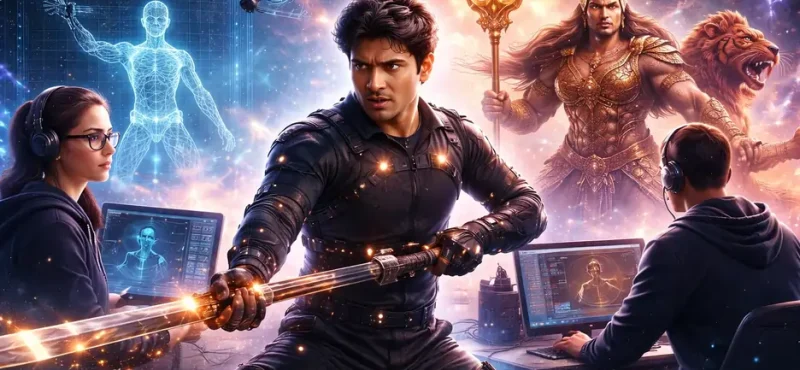
It’s happening behind the scenes, in quiet studios filled with cameras, sensors, and actors wearing strange suits covered in dots.
That quiet shift is called motion capture.
And today, motion capture movies in India are slowly moving from experimentation to mainstream filmmaking. If you work in animation, VFX, or storytelling or even just love cinema this is something you need to understand.
Let’s walk through it properly. No jargon. No confusion.
What is Motion Capture (MoCap)?
Imagine this.
An actor performs a scene not in costume, not on a grand set but in a simple suit with sensors. Every movement they make is tracked. Every gesture, every turn, even subtle body shifts.
That movement is then transferred to a digital character.
So instead of animators creating motion frame by frame, they capture real human performance and translate it into animation.
In simple terms:
- Actor performs → System records → Software converts → Character moves
That’s motion capture.
Why Motion Capture Matters in Movies
Traditional animation is powerful but it takes time.
Motion capture changes the process:
- Movements feel more natural
- Complex action scenes become easier to create
- Emotional expressions become more believable
- Production speed increases
Instead of building motion from scratch, filmmakers borrow reality and reshape it.
This is why motion capture movies in India are gaining attention.
🇮🇳 How Motion Capture Movies in India Started
India didn’t begin with big budgets or advanced labs. It started with ambition.
Kochadaiiyaan (2014)
This was India’s first major attempt at a full motion capture film.
- Used multi-camera capture systems
- Entire film built using performance capture
- Inspired by global films like Avatar
Now, honestly it wasn’t perfect.
The animation felt stiff at times.
But that’s not the point.
👉 It proved something important:
India could attempt motion capture filmmaking at scale.
That was the first step.
Where Motion Capture Movies in India Stand Today
Fast forward to today, and things look very different.
Technology has improved.
Studios are more experienced.
And the ambition is much bigger.
Let’s look at some key projects.
Adipurush (2023)
This film pushed motion capture into mainstream Indian cinema.
What technology was used:
- Xsens motion capture suits (wireless tracking)
- Facial capture systems
- Heavy VFX integration
What it achieved:
- Large-scale mythological characters
- Fully digital environments
- Performance-driven animation
Was it perfect? No.
But it showed that motion capture movies in India can handle massive cinematic scale.
Ramayana (Upcoming)
This is where things get serious.
The upcoming Ramayana project is expected to use:
- Advanced motion capture systems
- Volumetric capture (full 3D scanning of actors)
- Hollywood-level VFX pipelines
What this means:
Instead of just capturing movement, filmmakers will capture:
- Body
- Face
- Depth
- Light interaction
👉 This creates near-real digital humans.
Motion capture movies in India are no longer catching up.
They are stepping into global territory.
Rajamouli’s MoCap Lab (Future Projects)
SS Rajamouli is building one of India’s most advanced motion capture facilities.
Why this matters:
- Dedicated infrastructure
- High-end production pipeline
- Long-term vision for mocap filmmaking
👉 This is not a one-film experiment.
This is ecosystem building.
Types of Motion Capture Technology Used in India
Let’s simplify the tech side so it’s easy to understand.
1. Suit-Based Motion Capture (Xsens, Rokoko)
Actors wear suits with sensors.
Best for:
- Full body movement
- Action scenes
- Fight choreography
Advantage:
- Portable
- Doesn’t need huge studios
2. Optical Motion Capture (Multi-Camera Systems)
Multiple cameras track reflective markers on the actor.
Best for:
- High precision animation
- Film-quality production
Example:
Kochadaiiyaan used around 40–50 cameras.
3. Facial Capture
Tracks facial expressions in detail.
Captures:
- Eye movement
- Lips
- Micro expressions
Why it matters:
This is what makes characters feel alive.
4. Volumetric Capture
This is advanced.
Actors are captured in full 3D using multiple cameras from all angles.
Result:
- A complete digital version of the actor
- Realistic lighting and depth
5. Real-Time Engines (Unreal Engine)
Directors can see scenes live while shooting.
Benefit:
- Faster decision making
- Less guesswork
- Reduced production time
Why Motion Capture Movies in India Are Growing
The growth isn’t random. There are clear reasons.
1. Realism
Audiences expect more now.
Motion capture delivers:
- Natural movement
- Human-like expressions
- Better immersion
2. Efficiency
Animating complex scenes manually takes time.
Motion capture:
- Speeds up production
- Reduces repetitive work
3. Global Competition
Indian cinema is now competing internationally.
To match global standards, motion capture becomes essential.
4. Creative Freedom
Directors are no longer limited by physical sets.
They can:
- Build entire worlds
- Create impossible creatures
- Design large-scale battles
Impact on Animation & VFX Industry
For animation and VFX studios, this shift is huge.
Earlier:
- Animation = manual, time-intensive
- VFX = post-production heavy
Now:
- Performance drives animation
- Real-time tools reduce delays
For a studio like Incredimate, this opens doors:
- Faster project delivery
- More realistic character animation
- Ability to handle high-end international work
Motion Capture Suite Rental (A Growing Opportunity)
Here’s the practical side.
Most filmmakers and creators cannot afford their own motion capture setup.
It’s expensive:
- Equipment
- Space
- Technical team
So what do they look for?
👉 Rental motion capture suites.
What a Good Motion Capture Suite Should Offer:
- Full-body capture setup
- Facial capture system
- Real-time preview (Unreal Engine)
- Clean studio space
- Technical support team
Opportunity for Incredimate
This is where you can step in.
Instead of just offering animation services, you can provide:
👉 Motion Capture Suite Rental + Production Support
Services you can include:
- Mocap studio rental
- Character animation pipeline
- VFX integration
- Final rendering support
This turns your studio into:
👉 Not just a service provider
👉 But a production partner
The Future of Motion Capture Movies in India
The direction is clear.
- More films will adopt mocap
- Costs will decrease
- Technology will become accessible
- Indie creators will start using it
In a few years, motion capture movies in India won’t be “special cases.”
They’ll be normal.
Final Thoughts
Motion capture is not replacing animation.
It’s enhancing it.
It brings together:
- Human performance
- Digital creativity
- Technical precision
And that combination is powerful.
Motion capture movies in India are still evolving but the foundation is strong.
The studios that adapt now will not just follow trends.
They’ll lead the next phase of storytelling.
Frequently Asked Questions (FAQs)
Motion Capture Movies in India
1. What are motion capture movies in India?
Motion capture movies in India are films where real actors’ movements are recorded using sensors or cameras and then applied to digital characters. Instead of animating everything manually, filmmakers use real human performance to create more natural and realistic animation.
2. How does motion capture technology actually work?
In simple terms, actors wear special suits with sensors or markers. Cameras track their movements in 3D space. That data is then processed by software and transferred to a digital character. The result is animation that feels lifelike because it is based on real motion.
3. Which was the first motion capture movie in India?
Kochadaiiyaan (2014) is widely considered the first major motion capture film in India. It used performance capture technology to create a fully animated cinematic experience.
4. What are some popular motion capture movies in India?
Some key examples include:
- Kochadaiiyaan (2014)
- Adipurush (2023)
- Upcoming projects like Ramayana and large-scale films by directors like SS Rajamouli
These films showcase how motion capture movies in India are evolving with better technology and execution.
5. What technology is used in motion capture movies in India?
Common technologies include:
- Xsens motion capture suits (wireless body tracking)
- Optical camera systems (multi-camera tracking setups)
- Facial capture systems (for expressions)
- Volumetric capture (full 3D scanning)
- Real-time engines like Unreal Engine
Each of these tools helps create more realistic animation and faster production workflows.
6. Why are motion capture movies becoming popular in India?
There are several reasons:
- Better realism in characters and movement
- Faster production compared to manual animation
- Ability to create large-scale cinematic scenes
- Growing demand for global-quality VFX and animation
As audiences expect higher quality visuals, motion capture movies in India are becoming more relevant.
7. Is motion capture better than traditional animation?
Not necessarily better—just different.
- Traditional animation offers more creative control and stylization
- Motion capture provides realism and speed
Most modern films actually use a combination of both.
8. Are motion capture movies expensive to produce?
Yes, the initial setup can be expensive. It requires specialized equipment, studio space, and technical expertise. However, over time, it can reduce production costs by speeding up animation and reducing manual work.
9. Can small creators or studios use motion capture in India?
Yes, and this is a growing trend.
With tools like Rokoko and Xsens, along with rental motion capture studios, even smaller creators can now access this technology without investing heavily in equipment.
10. What is a motion capture suite rental?
A motion capture suite rental is a service where studios provide access to mocap equipment, space, and technical support.
Instead of buying expensive gear, filmmakers can:
- Rent the setup
- Record performances
- Use the data for animation and VFX
This makes motion capture movies in India more accessible to a wider range of creators.
11. How can Incredimate help with motion capture projects?
Incredimate can support motion capture workflows by offering:
- Animation and character rigging
- VFX and post-production
- Integration of mocap data into final scenes
- Potential motion capture suite rental services
This allows clients to move from concept to final output efficiently.
12. What is the future of motion capture movies in India?
The future looks strong.
- More films will adopt motion capture
- Technology will become more affordable
- Real-time production will increase
- Indian studios will compete globally
Motion capture movies in India are expected to become a standard part of filmmaking in the coming years.