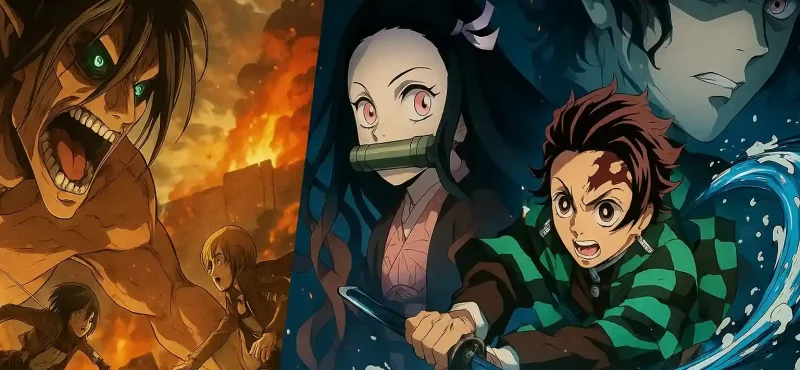
If you’ve spent the last few years binging anime, crying over dead protagonists, and screaming “Shinzo wo Sasageyo!” or “Total Concentration, BreathingFirst Form!”, then you already know Attack on Titan vs Demon Slayer isn’t just a comparison, it’s a clash of titans (literally and emotionally).
Two modern masterpieces. Two entirely different vibes.
One redefined anime storytelling, the other redefined anime art.
So grab your ODM gear and your Nichirin sword let’s break down Attack on Titan vs Demon Slayer across story, animation, and cultural impact from a fan’s heart and a critic’s brain.
⚔️ Storytelling: Titans of Emotion vs Demons of the Heart
Let’s start with story the soul of any great anime.
🧠 Attack on Titan: The Psychological Warzone
Attack on Titan (AOT) is storytelling on steroids.
It starts as a survival horror humanity trapped behind walls, monsters devouring people and slowly transforms into a political, moral, and cosmic nightmare.
Isayama didn’t just write a story; he built a philosophical puzzle.
Every season breaks your brain the morality flips, the heroes become villains, and the villains… well, they might’ve been right all along.
AOT asks hard questions:
- What does freedom really mean?
- Can humanity survive without conflict?
- Is revenge ever justified if everyone’s a victim?
By the final season, the Titans aren’t just monsters they’re metaphors for trauma, nationalism, and the endless cycle of hate.
It’s raw, heavy, and unapologetically complex.
When you finish it, you don’t just cry you sit in silence, rethinking your entire life.
💔 Demon Slayer: The Emotional Masterpiece
Now, Demon Slayer (Kimetsu no Yaiba) hits different.
It doesn’t twist your brain it squeezes your heart.
Tanjiro Kamado’s story is simple: a boy fights demons to save what’s left of his family. But the simplicity is its strength. It’s emotional storytelling done perfectly.
Every battle in Demon Slayer feels personal.
Each demon isn’t just evil they have regrets, pain, and memories that mirror the heroes.
That’s the beauty: even the monsters cry.
Where Attack on Titan screams “humanity is doomed,” Demon Slayer whispers, “humanity is worth saving.”
Tanjiro’s kindness, Zenitsu’s fear, Inosuke’s chaos it’s an emotional symphony that makes you feel alive.
👉 Story Verdict:
- Attack on Titan wins for depth, complexity, and unpredictability.
- Demon Slayer wins for heart, empathy, and emotional clarity.
Both are masterpieces one appeals to the mind, the other to the soul.
🎨 Animation: Ufotable’s Perfection vs MAPPA’s Madness
Okay, let’s talk visuals because let’s be honest, part of why we watch anime is to say “OMG DID YOU SEE THAT FRAME?!”
🌈 Demon Slayer’s Ufotable Magic
Ufotable didn’t just animate Demon Slayer they turned it into a painting that moves.
Every frame looks like art you’d hang on your wall.
The blend of 2D and 3D animation is flawless.
Sword forms like Water Breathing and Hinokami Kagura flow like dance choreography. The motion trails look hand-painted, and the lighting? Pure cinema.
The Mugen Train movie proved it: Demon Slayer isn’t just “good anime art,” it’s film-quality animation the gold standard for modern shonen.
Even filler episodes look better than most anime finales.
Every episode hits like a mini movie emotional, fluid, and color-graded to perfection.
🔥 Attack on Titan’s Grit and Evolution
Attack on Titan’s animation journey is its own story arc.
The first three seasons by WIT Studio gave us dynamic 3D maneuvering, bone-crushing Titan fights, and that signature gritty texture that made the world feel alive and dirty.
Then came MAPPA for the final seasons and they went full chaos mode.
The 3D Titans became smoother, the shading darker, the tone more cinematic. It’s not “beautiful” in the traditional sense it’s hauntingly raw.
The Rumbling sequence? Goosebumps.
Eren’s final transformation? Straight nightmare fuel.
MAPPA captured the horror and scale perfectly even if some fans miss WIT’s emotional touch.
👉 Animation Verdict:
- Demon Slayer = Flawless artistry and elegance.
- Attack on Titan = Raw intensity and cinematic emotion.
Both dominate in their own lanes Demon Slayer is like a painting, AOT is like a war documentary.
🌈 Demon Slayer – Ufotable’s Visual Symphony
Let’s talk production first.
Ufotable reportedly spends between $80,000–$100,000 per episode nearly double what an average anime episode costs.
Why? Because every frame is handcrafted like a film scene.
Instead of focusing on static beauty, Ufotable’s animators build motion as emotion. You don’t just see the Fire Breathing form you feel it.
The animation uses advanced compositing and dynamic camera moves combined with traditional brush textures a seamless marriage of 2D line art and 3D effects.
The lighting? Unreal.
The sword trails mimic Japanese calligraphy strokes.
Even the particle effects sparks, water, fire are animated individually, something we at Incredimate deeply admire and replicate in our own visual work.
(Read next: [How Ufotable Changed the Future of Anime Animation] – internal blog opportunity)
🔥 Attack on Titan – MAPPA’s Raw Realism
AOT’s animation history is its own war story.
WIT Studio gave us that iconic 3D ODM gear choreography — a blend of perspective physics and raw motion blur that looked impossible at the time.
When MAPPA took over, they reimagined it entirely
- More realistic lighting
- Cinematic depth of field
- Gritty texturing and shading inspired by European war cinema
The result? A sense of scale no anime has matched.
The Rumbling sequence? That’s a masterclass in digital cinematography. It’s not flashy it’s terrifyingly beautiful.
From a studio standpoint, MAPPA manages controlled chaos working with tight budgets and heavy schedules while delivering 4K-level cinematic quality.
That kind of craftsmanship takes stamina few teams possess.
(Internal link idea: [AOT Final Season Visual Analysis – How MAPPA Redefined 3D in Anime])
💡 Incredimate’s Take (Studio Perspective)
Both shows are visual benchmarks.
- Ufotable sets the gold standard for artistry and stylization.
- MAPPA sets the benchmark for scale, realism, and immersion.
At Incredimate, we’re inspired by both: the fluid motion techniques of Ufotable and the cinematic texture layering of MAPPA.
Our 3D & 2D teams often analyze these shows frame by frame for lighting references, motion rhythm, and design composition — because in anime, animation isn’t just movement; it’s emotion translated through physics.
💸 Budget, Design, and Technical Artistry
Let’s get real for a sec anime production isn’t all romance and magic brushes.
- Attack on Titan (MAPPA era) operates under intense schedules, sometimes finishing cuts mere weeks before broadcast. Despite that, their production efficiency and team coordination are unmatched.
- Demon Slayer, backed by Aniplex and Ufotable’s in-house compositing pipeline, invests heavily in color theory, 3D tracking, and hand-drawn over CGI a rare, costly hybrid.
If you compare budgets:
- AOT final season: ~$80,000–$90,000 per episode
- Demon Slayer: ~$100,000+ per episode
- Most average anime: ~$40,000–$60,000
That’s why Demon Slayer looks cinematic because it’s literally built like a film.
Every battle sequence could pass as a movie trailer.
From a production design viewpoint (and as an animation studio ourselves), both projects demonstrate where the anime industry is headed:
→ Smarter pipelines, stylized 3D integration, and artistic lighting over brute force rendering.
(Internal Link: [How Incredimate Uses Anime-Inspired Lighting in 3D Projects])
💀 Character Writing: Complexity vs Compassion
AOT characters are gray, scarred, and morally broken.
Eren Yeager’s final transformation is one of the most haunting arcs ever animated — hero, villain, and savior, all at once.
Demon Slayer’s characters, by contrast, are emotional archetypes with humanity at their core.
Tanjiro fights with love; Nezuko with instinct; Akaza with regret.
Even villains have backstories that make you cry before they die.
For writers and directors, this is storytelling diversity in action — AOT’s depth challenges your ethics, while Demon Slayer’s warmth restores your faith.
(Related Link: [Akaza vs Tanjiro & Giyu – The Battle That Defined Humanity])
🩸 Characters: Heart vs Survival
❤️ Demon Slayer Characters
Tanjiro is literally anime’s “golden boy.”
Empathetic, humble, and powered by grief instead of rage.
He’s the definition of pure-hearted strength.
Then there’s Nezuko, the perfect embodiment of humanity’s duality demon outside, heart inside.
Giyu, Zenitsu, Inosuke, Shinobu… every Hashira and demon has emotional depth.
Even villains like Akaza and Rui make you cry instead of hate them.
That’s Demon Slayer’s power it gives every soul, even a demon’s, a story worth remembering.
💀 Attack on Titan Characters
AOT characters are broken, layered, and morally gray.
Eren Yeager starts as a hotheaded hero and ends as a war criminal who thinks genocide is freedom.
Mikasa is loyalty turned obsession.
Armin is hope struggling against logic.
Even side characters like Levi, Erwin, and Reiner feel like main protagonists.
No one in AOT is “good.” Everyone is just human, which makes it terrifyingly real.
It’s character writing that stares straight into the abyss and doesn’t blink.
👉 Character Verdict:
- Demon Slayer: Warmth, empathy, and emotional growth.
- Attack on Titan: Complexity, trauma, and moral decay.
🌍 Cultural Impact: Legacy, Influence & Fandom Power
🌟 Attack on Titan’s Global Revolution
When AOT dropped, it didn’t just trend it took over pop culture.
It was the first anime to make even non-anime fans go, “Wait, what is this show!?”
It broke the internet every week during the final seasons.
Its music, symbolism, and sheer unpredictability turned it into a global event.
From AMVs to Reddit debates to political think-pieces AOT blurred the line between anime and philosophy.
It’s the kind of series you discuss in college, cry about at 2 a.m., and meme the next morning.
AOT became the anime of a generation.
🌸 Demon Slayer’s Modern Domination
Then came Demon Slayer the anime that saved the 2020s.
It broke box office records, won awards, and even outperformed Spirited Away at one point.
It’s the anime that introduced Gen Z Anime to high-quality animation and redefined what “mainstream” anime looks like.
Cosplays, TikToks, edits, merch Demon Slayer became an aesthetic and a lifestyle.
It’s emotional enough for casuals, deep enough for veterans, and beautiful enough for everyone.
And honestly? No anime has made so many people cry this consistently since Your Lie in April.
👉 Cultural Verdict:
- Attack on Titan = Changed anime forever.
- Demon Slayer = Changed how anime is seen forever.
AOT expanded the mind; Demon Slayer expanded the audience.
⚖️ Attack on Titan vs Demon Slayer – Final Verdict
| Category | Winner | Why |
| Story | Attack on Titan | Deep, layered, philosophical storytelling |
| Animation | Demon Slayer | Ufotable’s cinematic perfection |
| Characters | Draw | AOT = moral complexity, Demon Slayer = emotional purity |
| Impact | Draw | AOT redefined anime globally, Demon Slayer redefined anime visually |
🌙 The Future of Demon Slayer: Infinity Castle and Beyond
The Demon Slayer journey isn’t ending it’s leveling up.
Following the massive success of Mugen Train and the Swordsmith Village Arc, Ufotable is now deep into producing the Demon Slayer Infinity Castle movie trilogy. The first part, Akaza Returns, already stunned audiences in 2025, and fans can’t wait for Infinity Castle Part 2 and Part 3, rumored for 2027 and 2029.
These films will adapt the final manga arcs Infinity Castle and Sunrise Countdown bringing the war against Muzan to its cinematic peak. Each installment is expected to push the limits of Demon Slayer animation quality, with even larger budgets, next-gen compositing, and fluid 3D-camera choreography.
From a studio perspective, this trilogy is a masterclass in how Japanese studios fuse emotional storytelling with digital craftsmanship.
At Incredimate, our artists are hyped about how Ufotable uses painterly lighting and hand-drawn motion blur to maintain soul within CG environments.
And even after the finale? Expect Demon Slayer spin-offs, game expansions like Hinokami Chronicles 2, and art-book releases that keep the brand alive. The keyword for this phase is evolution Demon Slayer’s future will continue shaping how the world views premium anime production.
(Internal link idea: [Demon Slayer Infinity Castle Explained – What to Expect in the Final Trilogy])
🐉 The Future of Attack on Titan: Beyond the Rumbling
While Attack on Titan reached its emotional end, the Attack on Titan franchise still rumbles forward.
MAPPA’s final season cemented AOT as one of the greatest anime ever made but creators have hinted that future Attack on Titan projects could explore new timelines, side stories, and even global perspectives on the Titan curse.
Industry insiders expect special episodes or spin-off OVAs focusing on fan-favorites like Levi and Mikasa, plus anniversary re-releases in remastered 4K. A live-action adaptation reboot and interactive game projects are also on the radar, proving that Attack on Titan’s impact is far from over.
From an animation-studio lens, we’re excited to see how MAPPA’s technology hybrid 3D rendering, volumetric fog, and cinematic lens distortion will evolve in their upcoming series.
At Incredimate, we view AOT’s production pipeline as a benchmark for balancing realism, grit, and emotional intensity a formula every modern studio studies.
Even if Eren’s story has ended, the world he reshaped continues to inspire new creators. Expect new collaborations, exhibitions, and digital experiences that keep the Attack on Titan legacy alive well into the next decade.
💬 The Real Truth (from an Anime Fan)
At the end of the day, comparing Attack on Titan vs Demon Slayer isn’t about choosing a winner.
It’s about appreciating how they complement each other.
AOT gave us despair, politics, and existential chaos.
Demon Slayer gave us beauty, kindness, and cathartic healing.
One made us question humanity.
The other reminded us why it’s worth saving.
They’re two sides of the same coin one carved in steel, the other painted in flame.
And that’s the best thing about being an anime fan today
We get to experience both.
🌸 Final Thought
Whether you scream “Sasageyo!” or whisper “Nezuko-chan,” both shows remind us why anime is the most powerful storytelling art form on Earth.
Because in every Titan and every Demon…
There’s a piece of us. 💀🔥
❓ FAQs – Attack on Titan vs Demon Slayer
Q1. Which anime has better animation – Attack on Titan or Demon Slayer?
Demon Slayer easily takes the crown for visual quality. Ufotable’s blend of hand-drawn art and 3D compositing gives it a painterly, cinematic style unmatched in modern anime. Attack on Titan, animated by WIT Studio and MAPPA, focuses more on gritty realism, intense motion, and raw energy both are exceptional in their own categories.
Q2. Which story is deeper – Attack on Titan or Demon Slayer?
Attack on Titan delivers a more layered and philosophical narrative, exploring morality, politics, and human nature. Demon Slayer, on the other hand, uses emotional simplicity and heartfelt storytelling to connect with viewers. One challenges your intellect, the other moves your soul.
Q3. What is the future of Demon Slayer anime?
The future of Demon Slayer lies in the Infinity Castle movie trilogy, with Part 1 already released and Parts 2 & 3 expected in the coming years. These films will conclude the story with breathtaking visuals and emotional closure. Fans can also look forward to spin-offs, art books, and advanced gaming adaptations that continue the Demon Slayer universe.
Q4. What is next for Attack on Titan after the final season?
While Attack on Titan has concluded Eren Yeager’s main storyline, future projects are expected possibly spin-offs, special episodes, and global collaborations celebrating the franchise’s legacy. MAPPA may continue refining their animation technology in other projects inspired by AOT’s success.
Q5. Why are Attack on Titan and Demon Slayer considered the best modern anime?
Because both revolutionized anime in different ways. Attack on Titan redefined narrative depth and political storytelling, while Demon Slayer elevated animation quality and emotional resonance. Together, they represent the evolution of modern anime where art, emotion, and meaning collide.