If you’re part of the Gen Z anime fandom, you already know Demon Slayer isn’t just an anime, it’s a movement.
Whether you’ve binge-read the manga or rewatched the anime’s Mugen Train Arc for the fifth time (no shame 👀), you’ve probably had this thought:
“The manga hits emotionally… but the anime just feels different.”
So today, we’re breaking down the truth behind Demon Slayer Anime vs Manga through the lens of animation design, storytelling, emotion, and cultural impact.
As an anime lover and as an animation studio that studies design psychology daily (yup, we’re talking about Incredimate), we’ll go beyond fandom debates to reveal what really makes this series special, modern, and timeless.
🎨 The Anime: When Art Became a Superpower
Let’s start with the obvious: Ufotable changed the anime industry forever.
The Demon Slayer anime didn’t just adapt a story it created an art form.
From the swirling Water Breathing forms to the raging flames of Rengoku’s final battle, every scene screams “crafted by artists who actually care.”
✨ 1. The Budget and Craftsmanship
The anime’s production budget per episode is rumored to be one of the highest in anime history.
But what’s even more impressive is how Ufotable used that budget:
- Every color palette matches a character’s emotional arc.
- Fight scenes combine 2D and 3D animation with fluid cinematic camera pans.
- Lighting and particle effects are designed to evoke mood, not just movement.
This isn’t just action it’s animation engineering.
At Incredimate, we study techniques like this when creating our own animation sequences.
The Demon Slayer anime has become a blueprint for modern motion storytelling proving that emotional clarity and design precision can coexist in every frame.
📖 The Manga: Simplicity, Soul, and Stillness
Before the anime became a global sensation, Koyoharu Gotouge’s Demon Slayer manga quietly built an empire on raw emotion and authenticity.
🖋️ 1. Imperfect but Honest Art
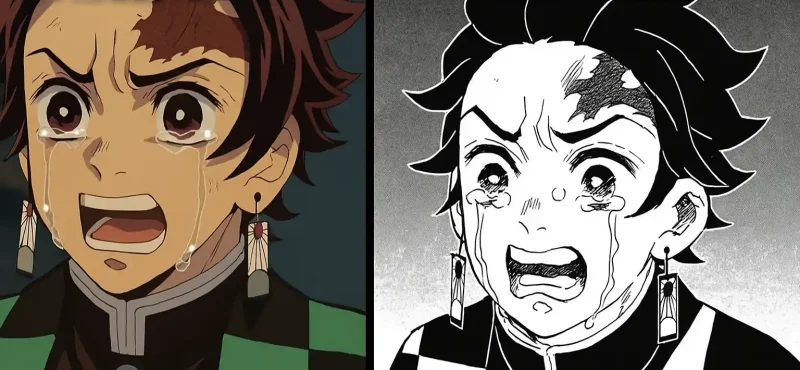
Gotouge’s art is not hyper-detailed it’s emotional shorthand.
The shaky lines, unrefined proportions, and expressive faces all work to make the characters feel alive.
You don’t just see their emotions; you feel them.
⏳ 2. Reader-Controlled Pacing
Unlike anime, where pacing is dictated by the director, manga readers decide their rhythm.
You can pause on a single panel maybe Tanjiro’s tear, or Akaza’s flashback and let it sink in.
That control creates a deep, personal connection.
The manga feels like a quiet confession, while the anime feels like a loud declaration of emotion both powerful in their own ways.
(Related: [Akaza vs Tanjiro & Giyu])
⚔️ Key Differences Between Anime and Manga
| Element | Manga | Anime |
| Visuals | Minimal, sketch-like panels with emotional focus | Ultra-detailed animation and 3D backgrounds |
| Pacing | Reader-controlled, slower emotional flow | Cinematic, faster tempo with music and effects |
| Emotion | Subtle and introspective | Explosive and visceral |
| Sound & Music | Silent storytelling | Haunting orchestral scores and breathtaking voice acting |
| Impact | Quiet immersion | Overwhelming spectacle |
💥 Why Gen Z Loves Demon Slayer So Much
Let’s be real Demon Slayer exploded during the social media era for a reason.
💫 1. Visual Aesthetic = Instant Shareability
Every shot looks like a wallpaper. Ufotable’s cinematic style makes every fight GIF-worthy. Gen Z fans love sharing clips, edits, and AMVs because the anime itself is built for virality.
🧠 2. Emotional Realism
Unlike older shonen that focused purely on strength, Demon Slayer blends trauma, empathy, and hope things Gen Z deeply resonates with. Tanjiro’s soft-hearted strength reflects a generation that values kindness just as much as power.
💎 3. Modern Storytelling Meets Timeless Emotion
The story feels ancient and spiritual yet visually futuristic a balance that defines Gen Z culture: nostalgia with modern vibes.
(Related: [Attack on Titan vs Demon Slayer )
🚀 New Trends: How Demon Slayer Is Shaping Anime’s Future
The Demon Slayer anime vs manga debate is also a look into where anime as a medium is heading.
🎬 1. Movie-Like Adaptations Are the New Norm
After the massive success of Mugen Train, anime studios realized cinematic releases can elevate storytelling and revenue.
Now, other studios are following suit from Jujutsu Kaisen 0 to Haikyuu!!: The Dumpster Battle.
🧩 2. Higher Budgets, Smaller Seasons
Instead of 40-episode seasons, anime is evolving into short, high-quality arcs with feature-film animation standards exactly like what Demon Slayer pioneered.
💻 3. Hybrid Animation Pipelines
The seamless mix of 2D and 3D art has become an industry benchmark. At Incredimate, we study this hybrid model closely integrating CGI motion and hand-drawn elements to achieve cinematic smoothness without losing authenticity.
🎨 4. Art Direction as Storytelling
Modern anime (inspired by Demon Slayer) now uses lighting, filters, and gradients to symbolize emotion not just aesthetics. That’s what we call “visual empathy design” in studio terms.
🔮 What’s Next for Demon Slayer: Future Updates & Projects
🎥 Infinity Castle Trilogy
The next big chapter for the anime is the Demon Slayer Infinity Castle movie trilogy, which will adapt the final arcs of the manga.
- Part 1: Akaza Returns released in 2025.
- Part 2 is expected in 2027, focusing on Upper Moons and the Castle collapse.
- Part 3 (2029) will wrap up the Sunrise Countdown Arc, closing Tanjiro’s journey in cinematic glory.
📺 Streaming and Global Rollout
Expect each film to hit global streaming platforms within a few months of theatrical release with subbed and dubbed versions launching simultaneously for worldwide fans.
🎮 Game and Franchise Expansion
The Hinokami Chronicles 2 game is rumored to include the Infinity Castle fights, and fans might see spin-offs featuring side characters like Giyu, Shinobu, or Rengoku in future mini-series or OVAs.
🧠 Why the Anime Is So Important for the Future of the Industry
The Demon Slayer anime vs manga comparison matters not just for fans but for creators, animators, and storytellers.
- It showed studios that investing in visual quality pays off globally.
- It inspired new animators to blend art and technology fearlessly.
- It opened doors for anime films to break box office records worldwide.
For animation studios like Incredimate, Demon Slayer is more than a reference it’s a creative benchmark.
It proves that great design, music, and emotional authenticity can turn an adaptation into an unforgettable experience.
❤️ The Emotional Heart of It All
At its core, both versions anime and manga tell the same story:
“Even in despair, kindness is the strongest form of strength.”
That’s why Demon Slayer connects so deeply with Gen Z.
It’s not just about power levels or breathing forms it’s about mental health, empathy, and resilience.
The anime paints that message with fire and light.
The manga writes it with silence and pain.
Together, they create one of the most complete emotional experiences in anime history.
🧩 Final Verdict: Art Meets Emotion, Ink Meets Flame
So, Demon Slayer anime vs manga who wins?
Both.
Because this isn’t a competition. It’s a collaboration across mediums.
The manga gives you the skeleton the soul, the essence.
The anime gives it breath, movement, and fire.
It’s proof that when heart meets craft, and when storytelling meets design anime becomes immortal.
❓ FAQ Section
Q1. What’s the difference between the Demon Slayer anime and manga?
The Demon Slayer manga tells the story with raw, emotional linework and slower pacing, while the anime enhances it with cinematic visuals, voice acting, and breathtaking sound design. Both offer unique emotional experiences.
Q2. Which is better the Demon Slayer anime or manga?
Neither truly outshines the other. The manga captures emotional purity and detail, while the anime delivers visual spectacle and atmosphere. Fans love both for different reasons.
Q3. Why is Demon Slayer so popular with Gen Z?
Gen Z connects to its emotional realism, artistic aesthetic, and themes of empathy and resilience. Every scene is visually stunning and shareable perfect for a generation that lives online.
Q4. What’s next for Demon Slayer after Season 4?
The story continues with the Infinity Castle movie trilogy Part 1 released in 2025, with Parts 2 and 3 expected in the coming years. These will conclude Tanjiro’s journey in grand cinematic fashion.
Q5. Why is the Demon Slayer anime important for the animation industry?
It revolutionized anime production by combining 2D and 3D techniques, emotional design, and feature-film budgets. Studios like Incredimate view it as a model for blending art and storytelling.