Rigging used to be invisible work.
No applause. No spotlight. Just quiet technical mastery holding the entire animation together.
In 2026, that has changed.
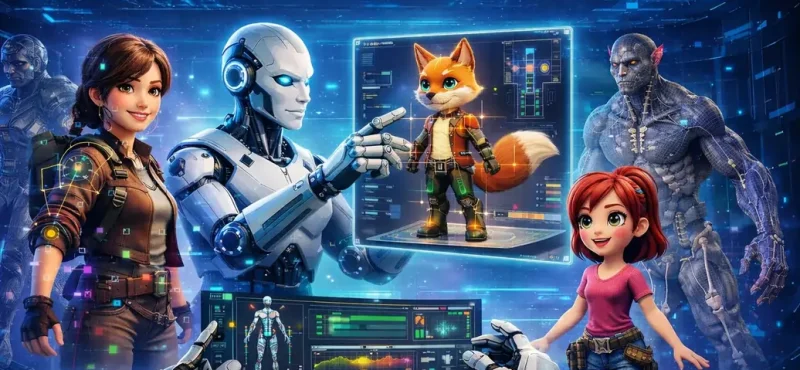
3D rigging is no longer a background task. It’s a strategic advantage. It defines how characters move, how machines articulate, how animatronic joints behave, and how scalable animation pipelines operate.
If you are exploring 3D rigging services, hiring a rigging studio, or considering outsourcing rigging, this is your deep-dive guide into what matters in 2026.
We’ll break down:
- What 3D rigging really is
- Why AI is reshaping rigging workflows
- How enterprise character rigging solutions are evolving
- The benefits of professional rigging services
- When to outsource rigging
- And how to plan future-ready animation production
Let’s go step by step.
What Is 3D Rigging and Why It Matters More in 2026
3D rigging is the technical process of building a digital skeleton inside a 3D model so it can move naturally.
A 3D rigger creates:
- Bone systems
- Control rigs
- Deformation setups
- Facial blendshape systems
- Mech rigs for machinery
- Animatronic joints for robotic articulation
Without rigging, a 3D model is just geometry.
With proper rigging and animation, it becomes alive.
In 2026, the complexity of digital characters has increased dramatically:
- Hyper-detailed facial rigs
- Muscle simulation layers
- Mechanical articulation systems
- Hybrid 2D rigging animation integration
Which means professional 3D rigging services are more critical than ever.
The Shift: From Manual Rigging to AI-Assisted Rigging
AI Rigging vs Manual Professional Rigging
| AI-Assisted Rigging | Professional Manual Refinement |
|---|---|
| Auto joint placement | Custom bone hierarchy engineering |
| Basic weight painting suggestions | Precise deformation correction |
| Faster setup | Animator-friendly controller design |
| Limited problem solving | Complex mech rig & facial system mastery |
AI is not replacing the rigging artist. It is accelerating the foundation.
In modern 3D rigging services, AI tools now assist with:
- Automatic joint placement
- Weight painting suggestions
- Retopology optimization
- Constraint system suggestions
- Auto-rig base generation
But here is the truth:
AI builds the base. A professional animation rigger builds the precision.
An experienced model rigger still:
- Refines deformation
- Corrects edge-case distortions
- Designs intuitive control systems
- Optimizes performance for real-time engines
AI reduces time. Expertise defines quality.
Why Enterprise Character Rigging Solutions Are Rising
In 2026, studios are not just creating characters. They are building scalable IP ecosystems.
An enterprise character rigging solution includes:
- Modular rig architecture
- Scalable facial systems
- Reusable body rigs
- Pipeline-compatible rig exports
- Engine-ready optimization
Large brands, game studios, OTT productions, and metaverse developers demand:
- Consistency
- Scalability
- Technical documentation
- Cross-platform adaptability
This is where a professional rigging studio separates itself from freelance work.
The Role of Rigging in Modern Animation Pipelines
Rigging and animation are inseparable.
A poorly built rig slows down animation teams.
A well-built rig:
- Speeds keyframe work
- Improves motion quality
- Reduces revision cycles
- Enhances character personality
At Incredimate-level production standards, rigging is designed for:
- Cinematic animation
- Real-time rendering
- AR/VR integration
- Industrial mechanical simulations
- Product animation workflows
Rigging today is pipeline infrastructure.
3D Rigging for Characters vs Mech Rig vs Animatronic Joints
Not all rigging is organic character work.
Let’s break down modern rigging categories.
1. Character Rigging
Includes:
- Biped rigs
- Quadruped rigs
- Stylized rigs
- Realistic anatomical rigs
Facial rigs now include:
- Micro-expression blendshapes
- Lip-sync layers
- Eye control systems
2. Mech Rig
Mech rigs are used for:
- Industrial machines
- Robots
- Vehicles
- Mechanical assemblies
Unlike character rigs, mech rigs prioritize:
- Constraint accuracy
- Rotation limits
- Technical articulation
Industrial 3D animation often requires precise mechanical rigging for assembly demos.
3. Animatronic Joints
These are used in:
- Robotics simulations
- Physical animatronic modeling
- Hybrid digital-physical projects
Here, motion precision matters more than stylization.
The Business Benefits of Professional 3D Rigging Services
Let’s talk business impact.
1. Faster Production Timelines
Clean rigging reduces animation bottlenecks.
Less technical troubleshooting = more creative focus.
2. Higher Animation Quality
Better deformation.
Cleaner movement.
More believable motion arcs.
3. Reduced Revisions
When rigs behave correctly, animation adjustments are faster.
4. Cross-Platform Compatibility
Modern rigging must support:
- Unreal Engine
- Unity
- Maya pipelines
- Blender workflows
- Real-time exports
5. Scalability
Enterprise clients need rigging systems that can be reused across projects.
Professional rigging outsourcing partners design with scale in mind.
When Should You Consider Outsourcing Rigging?
Why Outsource 3D Rigging Services?
Specialized Expertise
Access experienced 3D riggers and animation riggers with enterprise pipeline knowledge.
Faster Production
Parallel workflows reduce internal bottlenecks and accelerate delivery.
Scalable Systems
Modular rig structures built for long-term multi-project use.
Many studios choose outsourcing rigging when:
- Internal teams are overloaded
- Projects demand complex deformation systems
- Mech rigs require specialized expertise
- Enterprise pipelines need scalability
Rigging outsourcing works best when the partner:
- Understands animation production
- Follows structured documentation
- Delivers tested rigs
- Provides support during animation
Outsourcing rigging is not about cutting cost. It’s about gaining precision and speed.
Planning 3D Rigging Services in 2026
If you are hiring a rigging studio, planning is critical.
Step 1: Define Character or Asset Type
Is it:
- Organic character
- Stylized character
- Mechanical asset
- Animatronic system
Step 2: Determine Final Output Platform
Before any 3D rigging services begin, you must answer one critical question:
Where will this rig actually live?
Because rigging for film is not the same as rigging for a game engine.
A VR-ready character behaves differently from one built for industrial simulation.
The final output platform directly affects:
- Rig complexity
- Controller design
- Optimization level
- Performance constraints
- Export structure
Let’s break it down clearly.
🎬 1. Film Production
If the rig is built for film or cinematic animation:
- You can afford heavier rigs
- Deformation quality is prioritized over real-time performance
- Muscle simulations and complex facial rigs are common
- Render-time processing is acceptable
Film rigs often include:
- Advanced corrective blendshapes
- Detailed facial micro-controls
- High joint counts
- Layered deformation systems
The goal here is visual perfection.
Performance optimization is secondary because rendering happens offline.
🎮 2. Game Engine (Unreal / Unity)
Game engines demand a completely different approach.
Here:
- Performance is critical
- Joint counts must be optimized
- Real-time playback is mandatory
- Rigs must export cleanly to engine-compatible formats
A professional rigging studio will:
- Limit bone hierarchy depth
- Reduce unnecessary constraints
- Bake animation-ready skeletons
- Ensure engine-friendly control stripping
In games, efficiency equals survival.
If the rig is too heavy, frame rates drop.
📱 3. AR (Augmented Reality)
AR overlays digital assets into the real world.
This means:
- Extremely lightweight rigs
- Mobile optimization
- Fast loading
- Clean deformation with minimal overhead
For AR applications like product demos or animated mascots:
- Simplified rigs are preferred
- Clean topology is essential
- Real-time response is non-negotiable
AR rigs must balance realism with device performance.
🥽 4. VR (Virtual Reality)
VR raises the stakes.
In VR:
- The user controls perspective
- Close inspection is common
- Latency must be near zero
- Motion sickness must be avoided
This means rigs must:
- Be optimized for real-time physics
- Avoid heavy constraint chains
- Maintain smooth articulation
VR characters and mech rigs must respond instantly.
There is no room for lag.
🌐 5. Metaverse Platforms
Metaverse-ready rigs require:
- Cross-platform compatibility
- Avatar customization flexibility
- Engine-native skeleton structures
- Real-time interaction systems
Metaverse characters often need:
- Modular clothing systems
- Swappable accessories
- Expression presets
- Social animation loops
Here, scalability matters more than cinematic perfection.
🏭 6. Industrial Simulation
Industrial rigging is highly technical.
Used for:
- Machinery demos
- Assembly breakdowns
- Mechanical visualization
- Animatronic joints simulation
These rigs prioritize:
- Mechanical accuracy
- Rotational limits
- Constraint precision
- Engineering realism
A mech rig for industrial simulation must behave like the real machine.
No exaggeration. No stylization. Pure functionality.
Why This Step Matters
If you skip this planning stage, problems appear later:
- Overbuilt rigs slow down real-time engines
- Underbuilt rigs fail cinematic requirements
- Export errors cause pipeline delays
- Animation teams struggle with unusable controls
Professional 3D rigging services always begin with platform clarity.
Because rigging is not one-size-fits-all.
It is platform-specific engineering.
And in 2026, with AI accelerating production, the real advantage comes from strategic planning — not just automation.
The platform defines the rig.
Rig complexity depends on usage.
Step 3: Establish Animation Requirements
Will the asset need:
- Facial acting
- Action sequences
- Procedural motion
- Real-time optimization
Step 4: Choose Rigging Model
Options include:
- Custom rig
- Modular rig system
- AI-generated base rig + manual refinement
How AI Is Reshaping the Future of Rigging
In 2026, AI does three major things:
- Speeds base setup
- Suggests weight distribution
- Predicts deformation stress points
But human rigging artists still handle:
- Complex deformation zones
- Stylized exaggeration
- Custom controller logic
- Animator usability
The future is hybrid.
AI handles repetition.
Rigging artists handle intelligence.
2D Rigging Animation and the Rise of Hybrid Systems
Rigging is not limited to 3D.
2D Rigging Animation vs 3D Rigging
| 2D Rigging | 3D Rigging |
|---|---|
| Puppet tool & bone layers | Full skeletal systems |
| Explainer & stylized animation | Film, games, industrial use |
| Lower complexity | Advanced deformation control |
2D rigging animation in tools like After Effects and Toon Boom uses:
- Bone systems
- Puppet tools
- Hierarchical controls
AI now assists in:
- Auto-layer parenting
- Smart keyframe interpolation
- Expression-based animation controls
Hybrid 2D + 3D pipelines are common in 2026.
Studios integrate:
- 3D character rigs
- 2D stylized overlays
- Real-time compositing
The Role of the Modern Rigging Artist
The modern animation rigger is no longer just technical support.
They are:
- Pipeline architects
- AI integrators
- Cross-platform engineers
- Deformation specialists
A professional 3D rigger must understand:
- Anatomy
- Physics
- Engine constraints
- Animator psychology
Rigging artists for hire in 2026 must be multidisciplinary.
Free Rigging Software vs Professional Rigging Services
Searches for “free rigging software 2D” are common.
Free tools help learning.
But enterprise production requires:
- Stable pipelines
- Scalable systems
- Advanced deformation control
- Team-based workflows
Professional 3D rigging services go beyond tool availability.
They deliver reliability.
The Impact on Animation Quality
Better rigs = better storytelling.
Emotion flows through:
- Subtle facial deformation
- Weight-shift accuracy
- Joint realism
- Hand articulation
Poor rigs break immersion instantly.
Professional rigging is invisible when done correctly.
Future Outlook: 3D Rigging in 2026 and Beyond
Expect:
- AI-driven deformation prediction
- Real-time muscle simulation
- Engine-native rig compatibility
- Modular rig libraries
- Automated mechanical rig generators
But even in 2030, creative oversight will remain human.
Why Choosing the Right Rigging Studio Matters
If your project includes:
- Film production
- Product animation
- Industrial machinery demos
- AR/VR integration
- Metaverse characters
You need structured, professional rigging services.
A proper rigging studio:
- Documents systems
- Delivers tested rigs
- Supports animation teams
- Optimizes for performance
Rigging is not optional infrastructure.
It is core production architecture.
Final Thoughts
The future of 3D rigging services in 2026 is not about replacing artists with AI.
It is about precision.
It is about scalable systems.
It is about building characters and machines that move naturally across platforms.
AI accelerates rigging.
Human intelligence perfects it.
If animation is movement, rigging is the engineering behind it.
And in 2026, engineering excellence defines creative success.
Enterprise Character Rigging Workflow
Asset Review
Topology & deformation zones
Rig Architecture
Bone systems & controllers
AI Optimization
Auto-weight refinement
Testing & QA
Animation stress checks
Engine Export
Game / AR / VR readiness
Frequently Asked Questions About 3D Rigging Services in 2026
1. What are 3D rigging services?
3D rigging services involve building a digital skeletal system inside a 3D model so it can move, deform, and animate correctly. A professional rigging studio creates control systems, bone hierarchies, facial rigs, and deformation setups that allow animators to produce realistic motion in characters, machines, or mechanical assets.
2. How is AI transforming 3D rigging in 2026?
In 2026, AI assists 3D rigging by automating base skeleton placement, weight painting suggestions, retopology support, and deformation previews. However, AI does not replace the rigging artist. Human expertise is still required to refine deformation, design intuitive controls, and optimize rigs for specific production pipelines.
3. What is the difference between 3D rigging and animation?
Rigging is the technical setup that allows movement. Animation is the artistic process of creating that movement. Rigging and animation work together without a properly built rig, high-quality animation is not possible.
4. When should a company consider outsourcing rigging?
Outsourcing rigging is ideal when internal teams are overloaded, projects require complex deformation systems, or specialized mech rigs and enterprise character rigging solutions are needed. Professional rigging outsourcing ensures scalability, quality control, and faster production turnaround.
5. What is an enterprise character rigging solution?
Enterprise character rigging solutions are scalable rig systems built for large production pipelines. They include modular rigs, reusable facial systems, engine compatibility, and structured documentation to support multi-project usage across films, games, or metaverse platforms.
6. What is a mech rig in 3D animation?
A mech rig is a rigging system designed for mechanical objects such as robots, vehicles, machinery, or industrial equipment. Unlike organic character rigs, mech rigs prioritize rotational limits, technical articulation, and mechanical accuracy.
7. How do animatronic joints differ from standard character rigs?
Animatronic joints focus on mechanical realism rather than organic motion. They are commonly used in robotics simulations, industrial visualization, and technical animation where precision is more important than expressive deformation.
8. Is 2D rigging animation still relevant in 2026?
Yes. 2D rigging animation remains widely used in explainer videos, social media content, and stylized productions. Modern 2D rigs use bone systems and puppet tools to create efficient animation workflows, often enhanced with AI-assisted interpolation.
9. How do I choose the right rigging studio?
To choose the right rigging studio, evaluate their portfolio, technical documentation standards, pipeline compatibility, deformation quality, and support during animation production. A professional 3D rigger should understand both artistic and technical requirements.
10. What skills does a modern 3D rigger need in 2026?
A modern 3D rigger must understand anatomy, deformation systems, engine optimization, AI-assisted workflows, constraint logic, and animator usability. Rigging artists for hire in 2026 are multidisciplinary professionals combining technical engineering with artistic sensitivity.
11. Can free rigging software replace professional rigging services?
Free rigging software can support learning and small projects. However, enterprise-level production requires scalable systems, optimized exports, advanced deformation controls, and structured support that professional 3D rigging services provide.
12. Why is platform planning important before rigging?
Determining whether a rig will be used in film, game engines, AR, VR, metaverse, or industrial simulation affects complexity, optimization, and export structure. Platform-specific planning prevents production delays and performance issues.
Need Professional 3D Rigging Services?
From enterprise character rigging solutions to mech rigs and animation-ready systems, we build scalable, AI-assisted rigs optimized for film, games, AR, VR, and industrial production.
Start Your Rigging Project